
How to Spot a Bad Togo Replica: 7 Red Flags Before You Buy
 Pumela Design
A Togo has no frame. No springs, no legs, no hardwood skeleton hiding under the upholstery. Ducaroy designed it in the late 1960s specifically to remove all of that, and every piece since works the same way: layered foam, quilted, and nothing else.
That is what makes it comfortable, and it is also why bad replicas fail so badly. On a conventional sofa a frame can carry a cheap cushion for years. On a Togo there is nothing to carry it. If the foam is wrong, the sofa is wrong, and you will know within eighteen months.
Here is what separates a replica built like the original from one that only photographs like it. If you are new to the design, start with what a Togo sofa is before you compare builders.
1. The seller will not tell you the foam density
This is the first thing to ask and the fastest way to end a conversation with a bad seller.
Foam density is measured in kilograms per cubic metre, and it describes how much material is actually in the foam rather than how firm it feels. The two are not the same. A low-density foam can be made to feel firm at first and still collapse, because firmness is about the initial push and density is about what happens after ten thousand of them.
The figure repeated across independent buying guides is that seat foam below roughly 35 kg/m³ will compress and lose its shape within about two years of daily use. On a framed sofa that means a saggy cushion. On a Togo it means the silhouette itself goes, because the silhouette is the foam.
A seller who builds properly knows this number and will give it to you. A seller who dodges it, answers with “high-density foam” without a figure, or redirects to comfort language, is telling you the answer without saying it.
2. The price is under $600 for a full seat
Price is a proxy for the thing you cannot see. Foam is the single most expensive material in an all-foam sofa, and it scales linearly. There is no clever manufacturing trick that makes dense foam cheap.
Once a full-size seat drops under about $600, something has to give, and it is almost always density, because density is the one cost that is invisible in a product photo. Pleats still look like pleats. Colour still looks like colour. The foam is where the money went missing.
We broke the whole range down, original and replica, in our Togo sofa cost guide.
3. The pleats are pressed, not stitched
The quilted pleats are the Togo’s signature and the most commonly faked part of it. There are two ways to make them.
The correct way is to stitch each panel separately and assemble them, so the pleat is structural. The upholstery folds because the panels make it fold. The cheap way is to heat-press or topstitch a channel into a single sheet of material, which produces a line that reads as a pleat in a photograph and flattens under a sitting person.
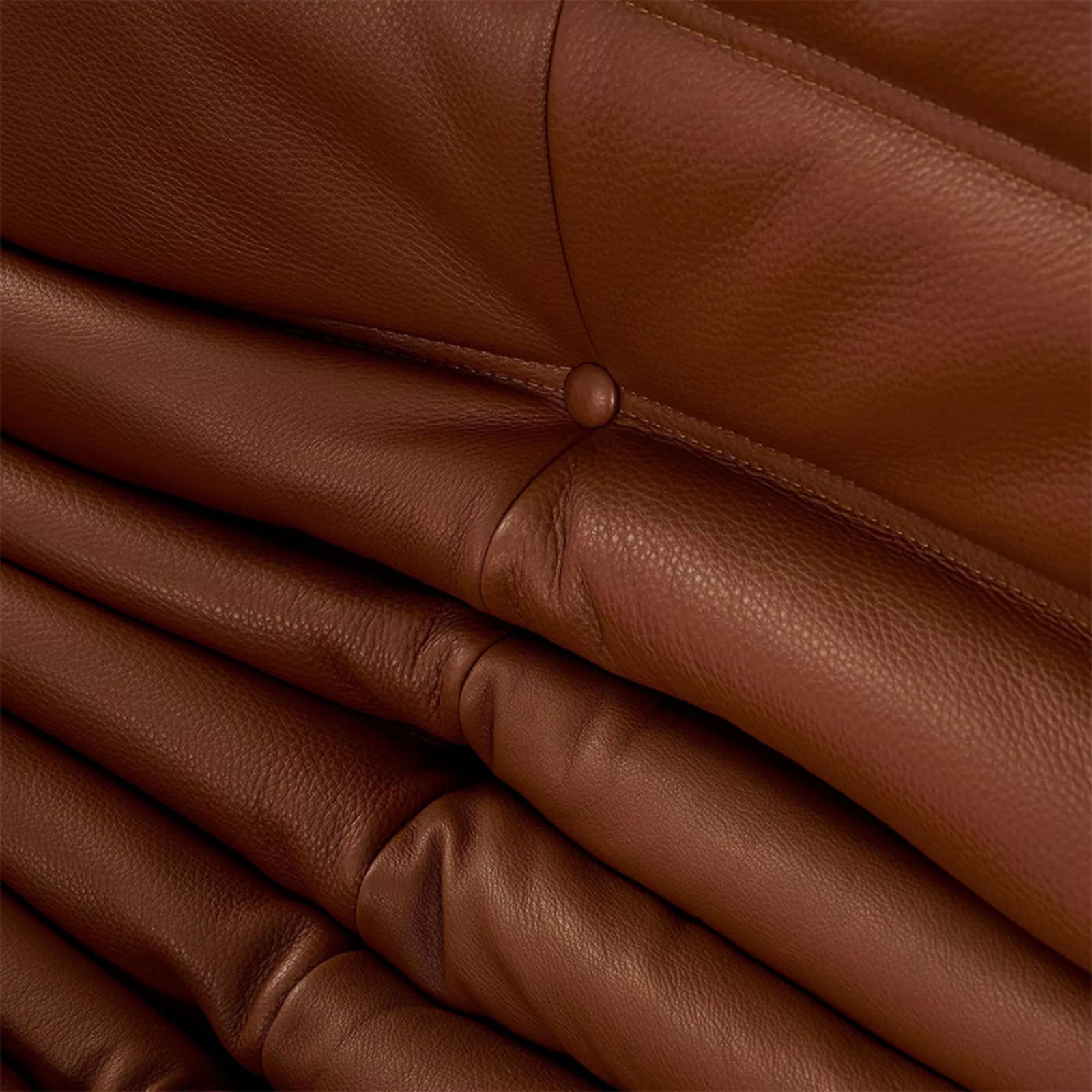
You can usually tell from a close-up photo: a stitched pleat has depth and casts a real shadow that changes as the piece is viewed from different angles. A pressed one looks like a drawn line. If the listing has no close-up photograph at all, assume the worst, because that omission is a decision.
4. The proportions are wrong
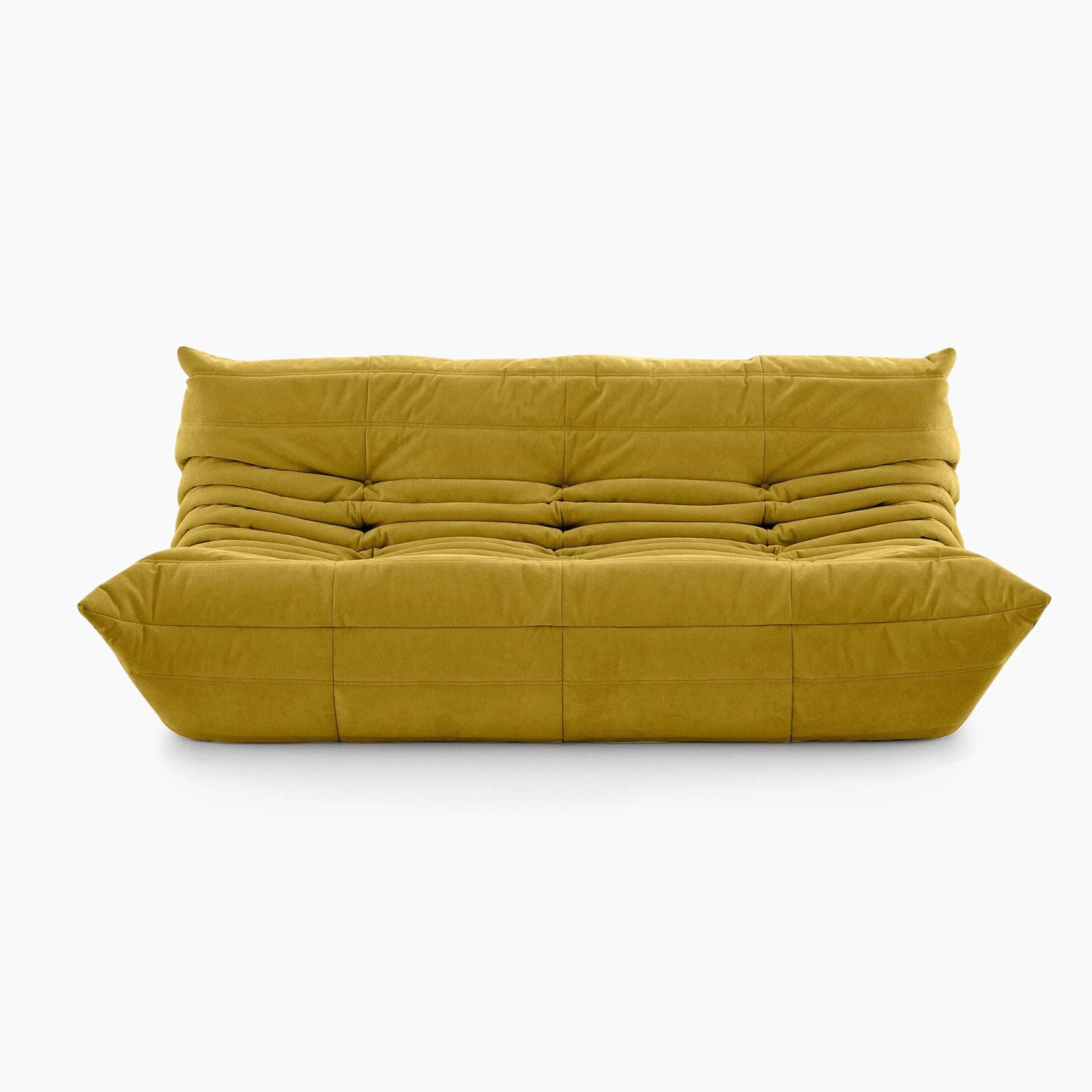
This is the giveaway that does not require touching anything. Bad replicas consistently get the proportions wrong in the same direction: too tall, too shallow, and the seat too high off the floor.
The Togo is a low sofa. That is the entire point of it. It pulls a room down into a lounge instead of arranging it like a waiting area. A replica that sits at normal sofa height has copied the pleats and missed the design.
Every seating piece we make shares a 27″ height, 40″ depth and 15″ seat height, which is what lets any two modules sit next to each other with the backs, arms and seat lines matching. If a seller cannot give you all three numbers for every module, they are not building a system, they are building lookalikes that happen to be sold together.
5. “Genuine leather” instead of full-grain
Leather grading is where furniture listings get deliberately slippery.
“Genuine leather” sounds like a guarantee and is close to the opposite. It is a specific, low grade: the split layers left after the strong top layer has been removed, often coated and embossed to imitate the grain it no longer has. It scuffs, it peels, and it does not develop a patina.
Full-grain is the intact outer layer, the strong one. It wears in rather than out, and on a piece you sit on daily, that difference shows up inside a year. “Top-grain” sits between the two and is acceptable. “Bonded leather” is neither, it is leather scrap bound with polyurethane, and it will crack.
The same slipperiness happens with Alcantara, which is a specific branded material, not a generic word for suede-like fabric. If a listing says “Alcantara-style,” it is not Alcantara. Choosing your own cover? Leather vs fabric Togo covers are compared in our separate guide.
6. No returns, or a return window under 30 days
You cannot evaluate a Togo from a photograph. The whole design is about how it gives underneath you, and nothing on a screen conveys that. Some people sit in one and immediately understand it. Others find it too low. Both reactions are legitimate and neither is predictable in advance.
So the return policy is not a customer service detail here, it is the only way to actually test the product. A seller confident in their foam offers a real window. A seller who is not offers 14 days, or offers 30 and quietly charges $300 in return freight.
Read the terms for who pays return shipping on an oversized item. That is where the policy is really written. Ours are on the returns page.
7. Stock photos, or the same photos as five other stores
Reverse image search a listing photo. If the identical image appears across a dozen storefronts under a dozen brand names, you are looking at a drop-shipper reselling an unnamed factory’s output, not a brand that made anything.
This matters beyond authenticity. A reseller cannot tell you the foam density because they do not know it. They cannot honour a foam warranty because they do not control production. And when the sofa fails in year two, the storefront is frequently gone.
Look for photography in real rooms, multiple angles, and detail shots of the stitching. Those are expensive to produce and drop-shippers do not produce them.
The checklist
Before you buy any Togo replica, get answers to these. In writing.
- What is the seat foam density in kg/m³?
- Are the pleats stitched panel by panel or pressed?
- What are the height, depth and seat height of every module?
- Is the leather full-grain, top-grain, or “genuine”?
- What is the return window, and who pays return freight?
- What does the warranty cover, and does it cover foam compression?
- Who manufactures it?
A seller who answers all seven without hedging is worth buying from, whether or not it is us. A seller who answers three has told you which four they are hoping you will not ask twice.
Frequently asked questions
What foam density should a good Togo replica have?
For seat foam, roughly 35 kg/m³ or higher is the figure repeated across independent buying guides. Density is not the same as firmness: a low-density seat can feel firm on day one and still collapse after daily use, because on an all-foam design the foam is the structure. Ask for the number in kg/m³. If the seller will not give it, treat that as your answer.
How can I tell stitched pleats from pressed ones?
Look at a close-up photo taken from an angle. A stitched pleat is assembled panel by panel, so it has depth and casts a shadow that shifts as the angle changes. A pressed or topstitched channel looks like a drawn line and flattens under weight. A listing with no close-up photo at all is itself a warning sign.
Is genuine leather a good material for a Togo sofa?
“Genuine leather” is a specific low grade: the split layers left after the strong outer layer is removed, usually coated to imitate grain. It scuffs, peels and does not develop a patina. Full-grain is the intact outer layer and wears in rather than out. Top-grain sits between the two and is acceptable.
What return policy should I look for?
At least 30 days, and check who pays return freight on an oversized item. A 30-day window with the seller arranging pickup is what makes buying an all-foam sofa safe, because you can only judge the sit in person. A short window, or a long one with heavy return freight, tells you the seller is not confident in the build.
What should a good Togo replica cost?
For a full-size seat, roughly $600 is the realistic floor. Below that the foam density is almost always too low to hold the silhouette, and there is no frame to save it. Well-built modules typically run from about $1,200 to $2,000. The full module-by-module breakdown is in our Togo sofa cost guide.
Our own answers are published on every product page, and the full range is on the Togo collection. Every piece is built on the same frame-free all-foam core as the original, upholstered by hand, with pleats stitched panel by panel and a water-repellent topcoat. If the sit is not right for you, send it back within 30 days.
Written by