
Best Togo-style ottomans in 2026

Best overall for coordinated lounging: a matching upholstered ottoman. Best for original-design ownership: the original Togo ottoman. Best for tight rooms: a compact footstool. Best for occasional surface use: a tray-compatible ottoman. This 2026 Togo ottoman guide ranks buying configurations by how you use them, with equal attention to pairing a footrest with a fireside chair or a full sofa.
TL;DR
Choose a Togo ottoman by seat height, usable floor space, upholstery care, and intended use—not pleats alone.
The original Togo ottoman suits shoppers who specifically want the original design, rather than inspired seating.
Pumela suits shoppers comparing Togo-style sofas and fireside chairs by fabric and color.
A matching upholstered ottoman is the default for lounging; choose a compact footstool when circulation comes first.
Why this matters
An ottoman has to work with your seat and your room. A close visual match is not enough if the top pushes your legs upward, blocks a doorway, or needs care you cannot accommodate.
Pumela offers Togo-style sofas and chairs in multiple fabrics and colorways. Start with that upholstery decision, then assess the footrest as a separate purchase. A familiar silhouette does not establish matching materials, construction, or support.
Pumela is best suited to shoppers comparing Togo-style seating by fabric and color rather than original-brand ownership. Its inspired seating should not be confused with the original Togo or treated as evidence of affiliation with Ligne Roset.
For an ottoman purchase, make the same distinction. Decide whether you want the original design, a coordinated lounging setup, a smaller footprint, or a usable secondary surface.
What makes the best Togo ottoman?
Use these criteria for your 2026 shortlist before comparing upholstery photos:
Height compatibility: Compare the ottoman with your occupied seat, not just the sofa's published dimensions. Upholstered surfaces compress under weight.
Footprint: Check the space during use and where the ottoman will sit when you need the walkway clear.
Support: Decide whether you want a forgiving footrest, occasional seating, or a firmer surface beneath a tray. Confirm permitted uses with the seller.
Upholstery and care: Identify the fabric, cleaning method, and whether any removable cover is actually washable.
Purchase terms: Read delivery, return, and warranty terms for the exact item and configuration.
Appearance is a final filter. Pleats, rounded edges, and a low profile cannot answer these practical questions.
Best Togo ottoman options at a glance
These are buying configurations, not claims that every seller offers each option. Start with the row that matches your main use.
Ranked option Best for Standout reason to choose it Key limitation Matching upholstered ottoman Coordinated lounging Lets you evaluate the seat and footrest as a pair Matching appearance does not guarantee matching support Original Togo ottoman Original-design ownership The choice when original identity is essential Identity alone does not settle fit or care requirements Compact footstool Tight rooms Prioritizes a smaller footprint over a broad lounging surface Less room to reposition your legs Tray-compatible ottoman Occasional surface use Combines a footrest with a place for a suitable tray Does not automatically replace a stable table
1. Matching upholstered ottoman: best for coordinated lounging
A matching upholstered ottoman is the default when your main goal is putting your feet up. Choose it alongside the seat rather than treating it as an accessory to solve later.
For a fireside chair, assess the pair from your normal sitting position. For a full sofa, decide which seat the ottoman serves and whether another person can pass while someone is using it. A footrest placed centrally is not automatically comfortable from every cushion.
Pumela's fabric and color choices give you a starting point for the seating side of that decision. Confirm any proposed ottoman pairing independently; a coordinated photograph is not a specification.
Matching upholstered ottoman pros:
Keeps upholstery coordination central to the purchase.
Supports a dedicated chair-and-footrest arrangement.
Lets you plan a sofa lounging position without choosing a fixed chaise.
Matching upholstered ottoman cons:
Separate pieces can differ in height, firmness, or fabric appearance.
The footprint remains occupied while you lounge.
A soft top is not automatically suitable for sitting or holding a tray.
Best for: You want a dedicated footrest and can reserve space directly in front of your preferred seat.
Buy: Choose the matching configuration after checking occupied seat height, care instructions, and the route around it.
2. Original Togo ottoman: best for original-design ownership
The original Togo ottoman is the relevant choice when ownership of the original design is the requirement. An inspired piece does not become the original because its outline or upholstery treatment looks similar.
Ask the seller to identify the exact item and provide its specifications and purchase terms. If you are comparing an existing original seat with a new ottoman, check the upholstery combination rather than assuming a familiar fabric name guarantees a visual match.
The Ligne Roset Togo alternatives guide provides a separate starting point when you are still deciding between original-design ownership and inspired seating.
Original Togo ottoman pros:
Addresses a specific preference for the original design.
Keeps original identity central to the buying decision.
Avoids treating similar-looking alternatives as interchangeable.
Original Togo ottoman cons:
Original identity does not guarantee the right height for an unrelated seat.
The design name does not replace fabric-specific care instructions.
A room still needs enough space for its actual dimensions.
Best for: You specifically want the original Togo ottoman, not simply a pleated, low-profile footrest.
Buy: Choose the original when original-design ownership is non-negotiable and the exact item passes your fit checks.
3. Compact footstool: best for tight rooms
A compact footstool prioritizes circulation. It is the better buying direction when a broad ottoman would force you to step around furniture every time you cross the room.
Measure the proposed footprint with tape before ordering. Include its position during use, not just the corner where you plan to store it. A footstool that fits beside a chair can still obstruct the room once you pull it forward.
Do not chase a miniature version of the sofa at the expense of function. Check that the usable top supports your preferred leg position, and confirm the item's weight if moving it regularly is part of your plan.
Compact footstool pros:
Makes circulation the first selection criterion.
Gives a single fireside chair a dedicated footrest option.
Allows a deliberate contrast instead of an uncertain fabric match.
Compact footstool cons:
Provides less surface for changing leg positions.
Does not serve multiple sofa seats at once.
Small dimensions do not prove low weight or easy handling.
Best for: You use one chair or one end of a sofa and need to preserve a clear route through the room.
Buy: Choose a compact footstool when the taped outline of a larger ottoman interferes with everyday movement.
4. Tray-compatible ottoman: best for occasional surface use
A tray-compatible ottoman suits a room where a footrest also needs to hold a book or a suitable tray. Start with the top: it needs to support the intended load without the tray rocking or tipping.
Do not infer stability from a flat-looking product photo. Ask about the surface and permitted uses, then assess the actual pairing. A tray spanning soft edges is a different arrangement from one resting securely on a supportive top.
Keep the trade-off clear. A surface chosen for resting your legs is not automatically the right place for an open drink, and adding a tray takes away lounging space.
Tray-compatible ottoman pros:
Gives one footprint more than one planned use.
Provides an alternative to adding a separate occasional surface.
Lets you remove the tray when you want the footrest back.
Tray-compatible ottoman cons:
The tray occupies space otherwise used for your feet.
Soft or uneven upholstery can undermine stability.
Spills still need treatment according to the upholstery instructions.
Best for: You need occasional surface space and are prepared to check the tray-and-ottoman combination directly.
Hold: Do not choose this configuration until surface stability and intended use are confirmed.
Check the fit before choosing the fabric
For your 2026 room plan, measure the seat and circulation together. A fireside-chair arrangement needs a clear approach to the chair; a sofa arrangement also needs access to the other seats.
Use 30–36 inches of walkway as a room-planning starting point where space permits. The familiar 14–18 inches between a sofa and coffee table is a separate reference for a reachable table gap, not an automatic rule for a footrest. Set an ottoman where your legs rest comfortably, then check circulation again.
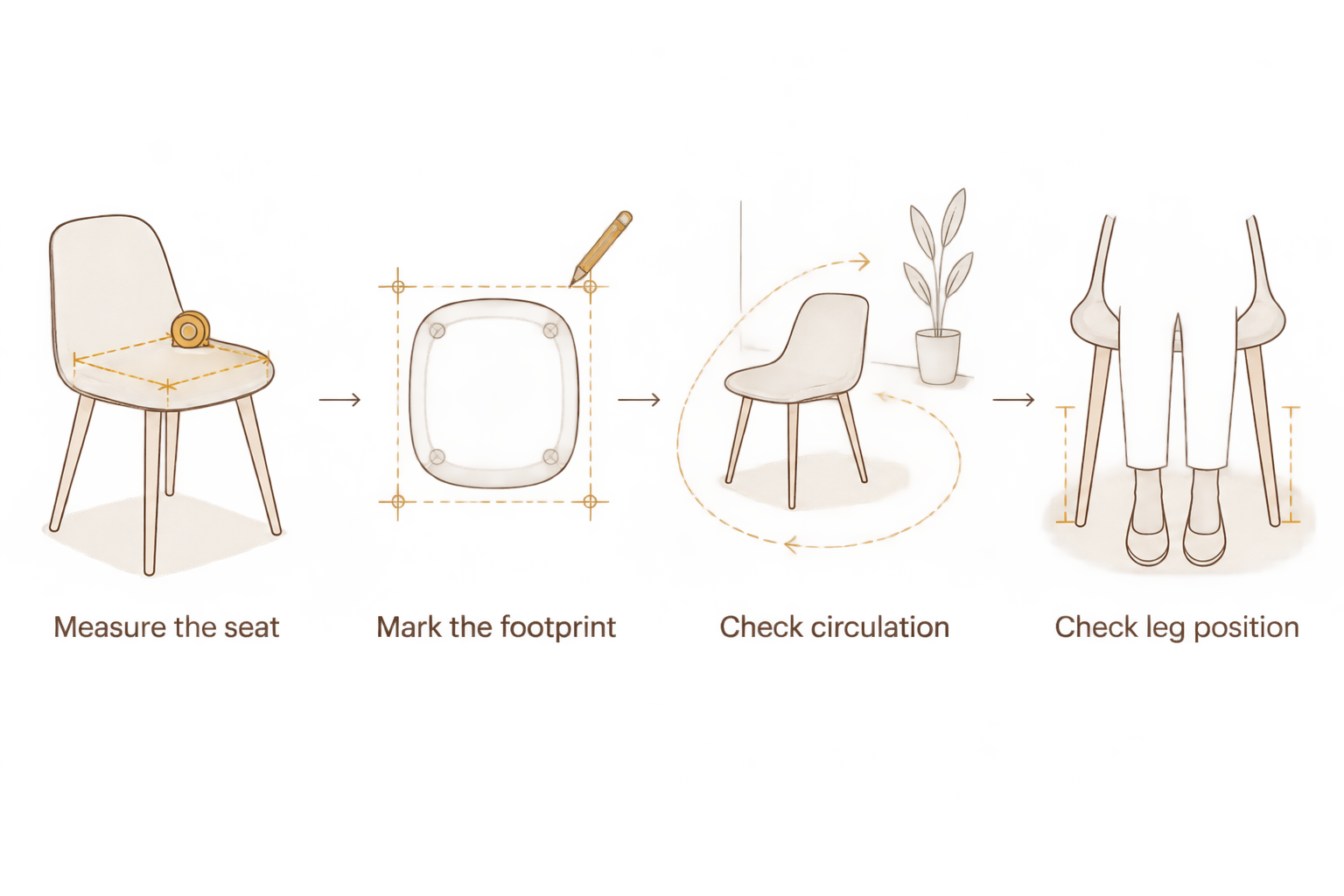
Work through this sequence:
Measure the seat: Record the front seat height and assess how far it compresses when occupied.
Mark the footprint: Tape the proposed ottoman outline on the floor, including rounded edges at their widest points.
Check circulation: Walk your normal route with the outline in place and the seating occupied.
Check leg position: Assess whether the proposed height and distance suit how you actually sit.
Record 3 dimensions for every candidate: width, depth, and height. Keep them beside the seat measurements so an appealing photograph does not displace the fit decision.
Compare upholstery and care without assumptions
Choose your 2026 upholstery shortlist around the care you will actually perform. Ask for the exact fabric description and cleaning instructions for the selected option, not a general statement covering an entire collection.
Compare fabric samples beside the existing seat in your own room. If coordination matters, request 2 samples for the proposed pairing rather than judging separate screen images. Look in daylight and under the lamps you use at night.
Keep these distinctions clear:
Removable is not washable. A cover can unzip without being approved for machine washing.
Similar color names are not a match. Compare physical samples when the pieces come from different collections or sellers.
A care claim needs instructions. Check the permitted method before applying water, detergent, or an upholstery treatment.
Pleats do not specify construction. Ask about internal materials and support rather than reading quality into the silhouette.
A useful care answer tells you what to do after a spill. A vague promise that a fabric is easy to maintain does not.
How the options are ranked
This 2026 ranking puts the main buying job first. A matching upholstered ottoman leads for dedicated lounging; the original Togo serves original-design ownership; a compact footstool prioritizes circulation; and a tray-compatible ottoman serves occasional surface use.
The criteria are height compatibility, footprint, support, upholstery care, and purchase terms. The order is not a claim of tested durability or construction quality. Move directly to the option that meets your requirement, then check the exact product against those criteria.
Which Togo ottoman should you choose?
Choose a matching upholstered ottoman if you mainly want a footrest. It is the clearest default for a fireside chair or a preferred sofa seat, provided the height and footprint work.
Choose the original Togo ottoman when the original design itself is the goal. Choose a compact footstool when circulation decides the purchase. Choose a tray-compatible ottoman only when you can confirm that the intended surface arrangement works.
For a 2026 purchase, settle the use case before comparing colors. That keeps an attractive upholstery choice from committing you to the wrong shape or footprint.
FAQ
What's the best Togo ottoman for everyday lounging?
A matching upholstered ottoman is the default for everyday lounging when its height and footprint suit your seat. Compare it with the occupied seat, then check that the arrangement leaves a usable walkway.
Is an original Togo ottoman the same as Togo-style inspired seating?
No. The original Togo ottoman and Togo-style inspired seating are distinct choices. Similar appearance does not establish identical construction, materials, quality, or affiliation with Ligne Roset.
Can I pair a Togo-style ottoman with a fireside chair?
Yes, provided the ottoman's height, distance, and support suit the chair and your sitting position. Check the pair together rather than choosing solely by fabric or silhouette.
What size ottoman should I put in front of a full sofa?
Choose the ottoman size around the seats it will serve and the circulation you need to preserve. Tape its full footprint on the floor and check access to the other sofa seats.
Can a soft ottoman replace my coffee table?
A soft ottoman is not automatically a suitable coffee-table replacement. Confirm that the top supports your intended tray securely, and keep drinks off any unstable arrangement.
Does a removable ottoman cover mean I can machine-wash it?
No. A removable cover is machine-washable only when its care instructions explicitly permit that method. Check the instructions for the exact fabric before cleaning.
Does Pumela's Togo-style seating imply affiliation with Ligne Roset?
No. Pumela offers Togo-style inspired sofas and chairs, which should be distinguished from the original Togo. Do not infer affiliation or identical construction from the visual style.
One last thing
Check the ottoman's parking spot as carefully as its lounging position. Tape both outlines before ordering. Open the nearby door, walk to the sofa, and sit in the fireside chair with the proposed footprint marked.
An ottoman should not need to move every time someone enters the room unless you have deliberately planned for that. Choose its everyday location first. Then choose the upholstery you want to look at there.